A fast, production‑grade, AI Planner
Autoplan Studio solves planning and scheduling problems where others crash or time out, and shows you every step of how it got there. In your browser, with nothing to install.
Free for non-commercial use. Sign in.
One planner for sequences, resources and time.
Temporal
Durative actions that overlap, continuous change over time, and deadlines. Plans come with start times and a makespan.
Numeric
Fuel, capacity, money and other quantities, with costs to minimise. Resource limits are respected in every plan.
Classical
Logistics, routing and puzzles at scale, with types, conditional effects and derived predicates.
Checked and shown
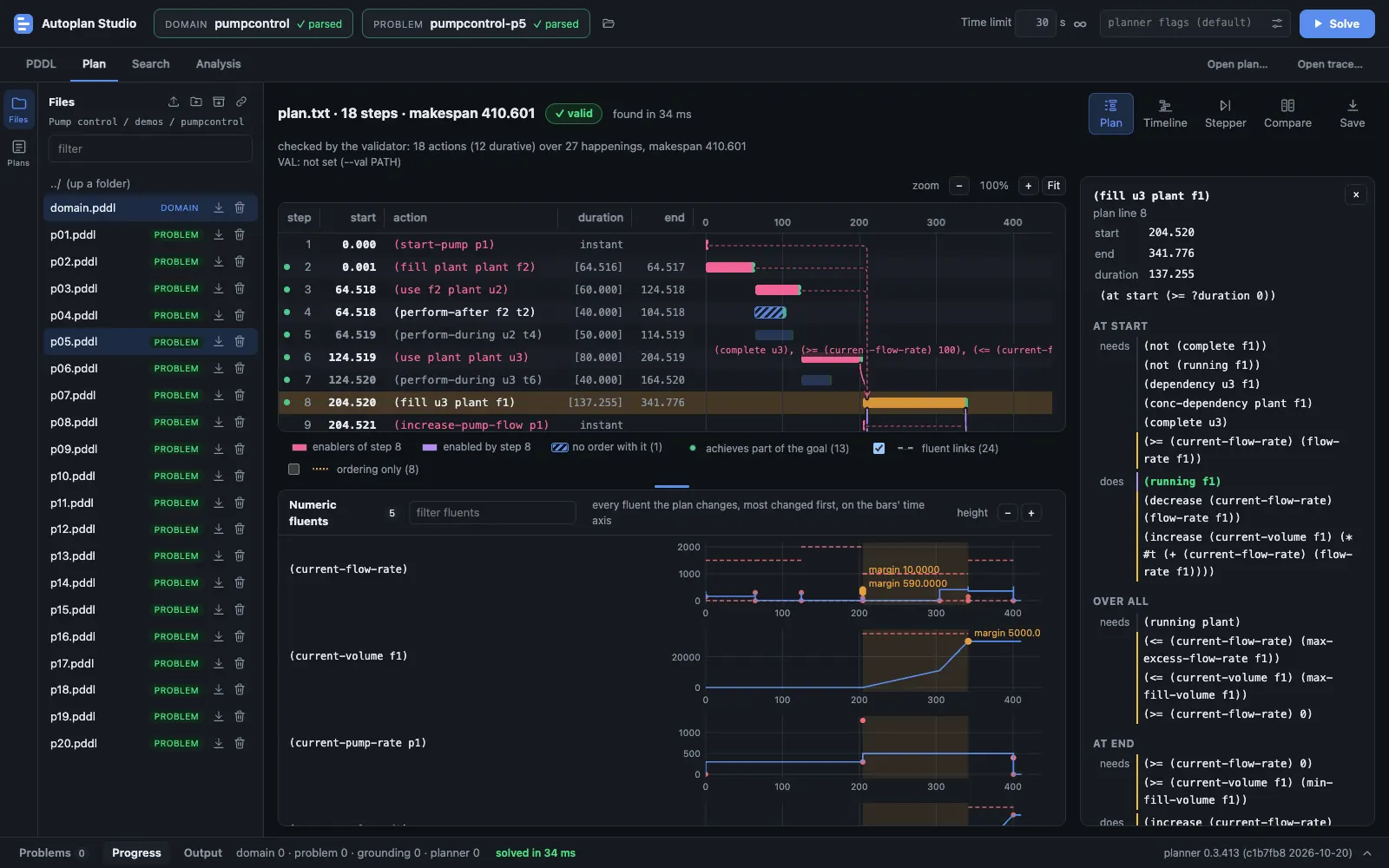
Every plan is validated, then drawn as steps, a Gantt timeline and charts of every quantity it changes.
Does it support your domain?
Feature by feature against 13 other planners, from Fast Downward, ENHSP, POPF and OPTIC to the 2026 numeric competition's leaders.
How does it perform?
Measured on all 6,384 problems from eleven International Planning Competition tracks, against 14 other planners under identical limits.
New to planning, or to PDDL?
What is AI Planning?
States, actions and goals, how planners search, and where planning is used.
The PDDL guide
The syntax, a walkthrough, and what changed from PDDL 1.2 to 3.1 and PDDL+, with examples you can run.
The planners
LAMA, ENHSP, POPF, OPTIC and others: who built them, how they work, and their papers.
Built to run in critical systems.
Fast enough for real deadlines, predictable under load, and every plan checked before you see it.
The parser, planner and validator are all written in Rust. This rules out a whole class of memory errors and latency issues, such as garbage collector pauses, guaranteeing robust, consistent, and efficient runs.
Peak memory and search progress are reported live on every run, so a hard problem shows where its time and memory go.
The planner is a single native binary with no runtime or interpreter. Autoplan Studio runs that same binary, so what you see here is what you deploy.
Every build reports the exact version it was made from, so a result can always be traced back to the code that produced it.
1 Unsafe code is confined to a handful of small, reviewed low-level calls, such as reading memory usage and counting allocations.
Bring your own problem.
Sign in to write and solve your own PDDL domains, keep your workspaces and share them with your team.
Sign inFree for non-commercial use.